How to Choose Kitchen Knives: Tescoma, Masahiro Review and Care Guide

A kitchen and its equipment are an important part of everyday life, since we spend plenty of time by the stove and prep table. You can save hours in different ways: cooking from semi-finished foods and fast food (which your body will hardly thank you for) or constantly ordering takeout from cafes and restaurants, which gets expensive. It makes far more sense to equip your kitchen with comfortable, well-made tools – then cooking itself goes faster and becomes a genuine pleasure.
 Japanese kitchen knives from the Masahiro MSC series (MS-300 set)
Choosing kitchen knives is the foundation of comfort at the prep board. A cheap $1 stall knife will cut something too, but the difference compared to a well-ground, balanced blade is obvious from the very first slice.
Stalik Khankishiev’s Video on Choosing Kitchen Knives
To start, I recommend watching a practical video (in Russian) by culinary author Stalik Khankishiev on how to choose knives for home cooking, what to look for in blade geometry, and how to handle them properly:
I always enjoy watching Stalik’s episodes: he talks about cooking and kitchenware with such warmth and attention to detail that even simple vegetable prep turns into a clear, enjoyable craft.
Japanese Masahiro Knives and a Practical Choice for Home
When talking about benchmark Japanese blades, it is worth mentioning Masahiro from Seki City, Japan (the lead photo shows their popular home series Masahiro MSC made from proprietary MBS-26 stainless steel). In terms of grind geometry, out-of-the-box sharpness, and build culture, these are outstanding tools.
At the same time, not every family needs expensive professional or Japanese knives that require delicate handling and whetstone sharpening. It is great to know how renowned bladesmiths work, but for an everyday home kitchen people usually look for more accessible, practical models – with a sensible balance of price, edge retention, and low maintenance.
Personal Experience: Czech Tescoma Knives (Presto, Sonic, Professional, and Azza)
After reading reviews, comparing knives in person, and testing them in daily cooking, I settled on the Czech brand Tescoma. Founded in 1992 in the industrial city of Zlín, Czechia, the company has been designing and manufacturing kitchenware and cutlery for over 34 years, developing its own product lines in-house and exporting to dozens of countries.
In stores you most often come across several Tescoma knife lines: Presto, Cosmo, Sonic, Professional, Morpho, and Azza. Out of these, I have personally used the Presto, Azza, and Sonic series.
By blade shape, balance, price, and the practical black handle, my favorite turned out to be the Tescoma Sonic series:
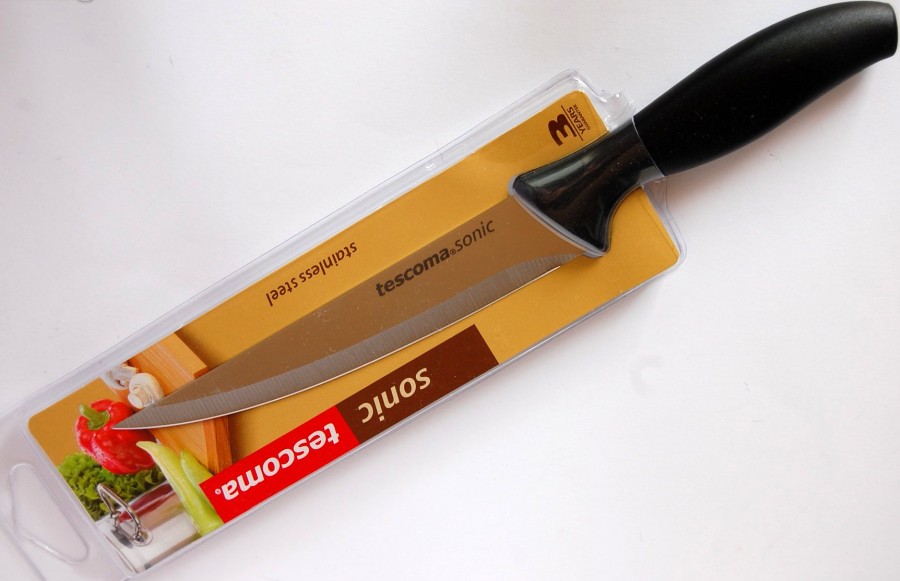 Tescoma Sonic utility kitchen knife (12 cm / 4.7 in) in factory packaging
Here is a brief comparison of the brand’s main lines based on my impressions:
- Presto series – inexpensive entry-level knives with lightweight, ergonomic colored or blue handles for everyday tasks;
- Sonic series – a great everyday middle ground with a comfortable black handle, good blade grind, and affordable price;
- Professional series – looks more substantial and upscale, but costs roughly 2–3 times more than the Sonic line;
- Azza series – heavy forged knives made from a single piece of steel with a classic riveted handle, though the price tag is significantly higher and the steel feels relatively soft in practice and user reviews.
I also own a large Tescoma Azza chef’s knife at home, but in actual daily cooking I rarely reach for it. Compact and mid-sized knives from the Sonic line ended up being the true workhorses in our kitchen. Moreover, their modest price makes it easy to simply replace a couple of the most heavily used sizes every 1.5–2 years if you do not feel like spending time on full resharpening.
How to Choose Kitchen Knives Without Overpaying for Extras
The biggest mistake when shopping is buying a bulky 7-to-10-piece block set where only one or two blades ever see real work. For 95% of home cooking tasks, it is enough to assemble the classic three-knife kitchen trio:
- Chef’s knife (18–20 cm / 7–8 in) or Japanese santoku (16–18 cm / 6.5–7 in) – the primary tool for fast cabbage and herb chopping, slicing meat and fish, and dicing large vegetables;
- Utility knife (12–13 cm / 4.7–5 in) – the most frequently used everyday helper for slicing cheese, sausage, bread, tomatoes, and quick prep jobs;
- Paring knife (8–9 cm / 3–3.5 in) – a short, maneuverable blade for peeling potatoes, carrots, apples, and garlic or doing fine in-hand work.
When choosing a blade, pay attention to Rockwell steel hardness (HRC) and how thinly the blade is ground toward the cutting edge. For European-style home knives, the sweet spot is 54–58 HRC: this stainless steel resists moisture, does not chip if it accidentally touches a bone, and hones back in thirty seconds. Japanese blades (58–61 HRC) cut more aggressively and hold a razor edge longer, but require careful cutting technique without lateral twisting.
- Right cutting board: cut only on wooden or quality plastic (polyethylene) boards. Glass, ceramic, and stone boards ruin a sharp edge in just a few strokes.
- Hand-wash only: never put kitchen knives in the dishwasher – hot water, harsh alkaline detergent tablets, and knocking against other dishes quickly dull the edge and damage handles. Rinse the blade right after use and wipe it dry.
- Regular honing rod maintenance: a European knife at 54–57 HRC stays sharp much longer if you realign the edge with a ceramic or steel honing rod in a few light strokes before cooking.
- Safe blade storage: store knives on a wall-mounted magnetic strip, in a wooden block, or inside individual blade guards rather than loose in a cutlery drawer mixed with forks and spoons.
Let me know in the comments – which kitchen knives do you use at home, which brands have earned a permanent spot in your kitchen, and why?
P.S. For cookware, we chose the Krauff 26-242-005 set (Strich series made of 18/10 stainless steel – three pots with lids and a multi-layer base) plus a Krauff frying pan with a lid. Comparable Tescoma pots and pans were significantly more expensive at the time.