Funny Trading Chart Pictures and a Joke About Brokers and Traders

Funny pictures drawn right in the trading terminal. To bring some fun and color into the harsh trading routine, plenty of traders get creative like this :-)
 Here is a lovely little dragon
Below are seven more chart pictures, the perfect trader from the natural world and a joke about brokers and traders. And at the end – what these jokes actually teach.
Pictures from the trading terminal
A wigwam, or maybe even a whole yurt with an Eskimo and a reindeer:
 Forex wigwam
You can’t do without an accordion:
 Accordion on the chart
And I will remember this dolphin: the price strained upward for a long time, then the dolphin burped, and the euro poured down hard.
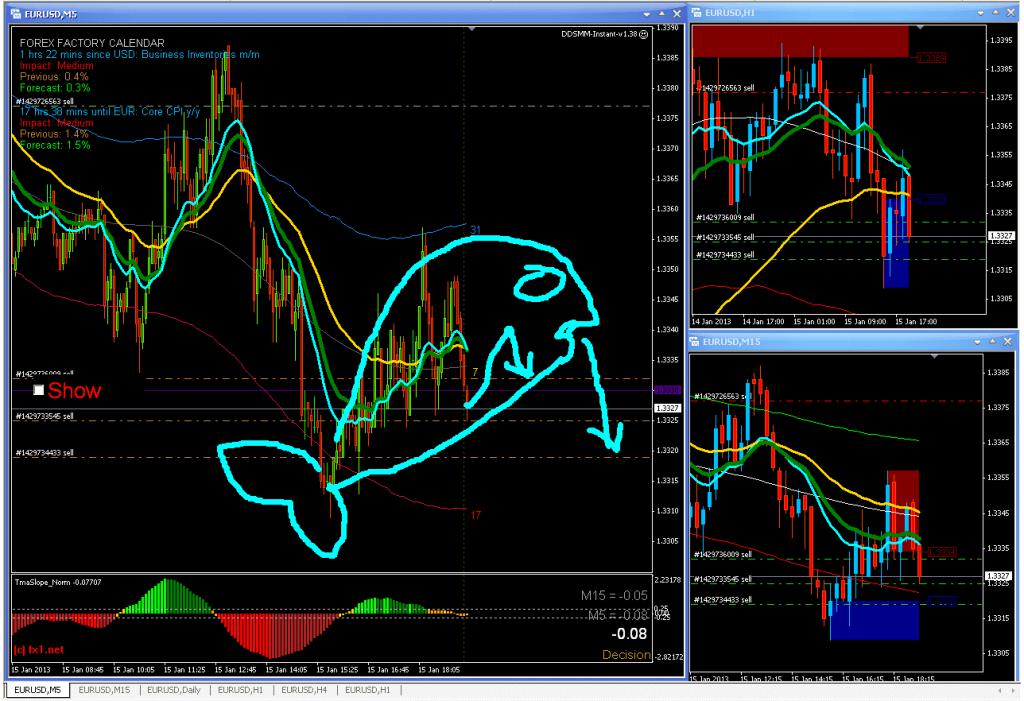 The dolphin
And this one is a market classic: you really want to go somewhere, and the market shows you a well-known gesture.
 The market’s answer
 A dragon, beautiful and colorful
 “Glory to the CPSU” – a Soviet-era slogan
 Jedi on the forex market
These pictures piled up over several years more or less by chance. Some of them definitely came from a forex forum where I was an active reader for a while and posted now and then, and where the rest came from I no longer remember.
The perfect trader is a frogfish
Richard Dennis’s “Turtles”, Bill Williams’ “Alligator”, bears, bulls – all very well, but the perfect trader has been found. It is the frogfish (family Antennariidae), a member of the anglerfish order. Camouflage and reaction – 100%.
 This is what the perfect trader looks like
It sits motionless for a long time, looking like a sponge or a tuft of algae, and wiggles its “fishing rod” – a growth on its head with a lure at the tip. When a small fish swims close enough, the frogfish snaps its mouth open so fast that the mouth volume grows up to 12 times, and swallows the prey in about 6 milliseconds – faster than a person can blink.
A trader’s job is the same: sit and wait for the conditions to enter a position, and once all the conditions are met, enter quickly and precisely and exit just as quickly, at the take-profit or on a signal. Nature is wise, and it is worth learning from it.
By the way, you can hand the waiting over to a robot: develop an algorithm, write or order an Expert Advisor, and it will hunt for profit for you :-)
A joke about brokers and traders
This joke is told in many versions with different characters, and the market version goes like this.

Three brokers and three traders went on a trip by train. Before the trip, the traders bought three tickets, while the brokers bought only one. The traders were pleased: those foolish brokers were going to pay a fine.
However, when the conductor went to check tickets, all three brokers went into the toilet. The conductor noticed that someone was inside and knocked on the door. A hand with one ticket came out from behind the door. He checked it and moved on, and the brokers saved two thirds of the ticket price.
The next day, the traders decided to use the same trick and bought only one ticket. The brokers didn’t buy any tickets at all!
When the traders saw the conductor, they went into the toilet and, hearing a knock, held their ticket out from behind the door. They never got it back: the brokers took the ticket and went into another toilet.
As Pushkin wrote, “the tale is a lie, but there is a hint in it, a lesson for good fellows.” A broker earns the spread and commission whatever the outcome of a trade, while a trader risks their own money. And copying someone else’s tactics without understanding what makes them work turns out expensive.
What these jokes teach
Behind the dragons and jokes lies some grim statistics: most retail traders lose money. There is a well-known demotivational poster – a scientist at a blackboard covered in formulas, with a caption along the lines of “Lost again? Borrow from your neighbor and try once more.” Formulas don’t save you, and the urge to win it back kills a deposit more often than the market itself.
- Wait for your signal. Like the frogfish: enter only when your system’s conditions are met, not out of boredom.
- Don’t chase your losses. After a losing streak, take a break and review your trades instead of borrowing for a new deposit.
- Limit your risk. Risk only a small part of your deposit on a single trade (1–2% is the most common advice) and always set a stop-loss.
- Count your costs. Spreads and commissions eat into the profit of frequent trades, especially on a small deposit.
- Start with a demo account. Test a system with virtual money first and only then with real money.
If you are interested in investing or trading, see the “Recommended” page: it lists services that my friends and I use ourselves.