Egypt: Luxor – The Mortuary Temple of Queen Hatshepsut in Deir el-Bahari

While browsing travel clips of Egypt, I was immediately reminded of visiting one of the country’s most striking monuments – the Mortuary Temple of Queen Hatshepsut at Deir el-Bahari, typically visited on a day excursion from Hurghada to Luxor.
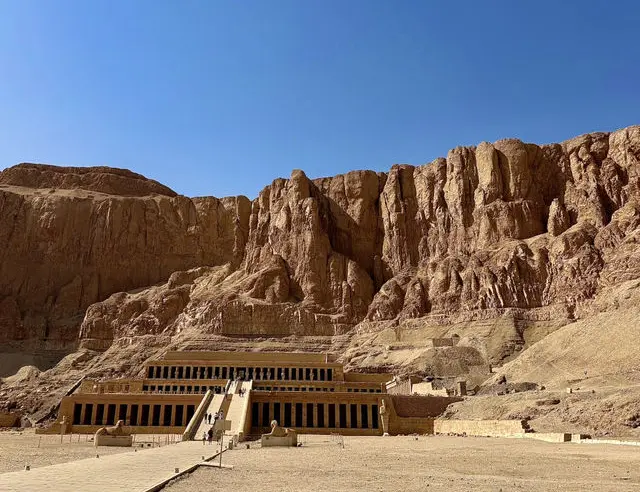 Temple of Queen Hatshepsut at Deir el-Bahari (Luxor): author’s photo
The desert air in this valley is remarkably dry: humidity is near zero, and as you walk toward the central ramp, the sheer limestone cliffs seem to tower straight overhead as if they might tumble down at any moment. I went there about seven years ago with a 35mm film point-and-shoot camera, had the photos printed right in Hurghada, and still consider Deir el-Bahari the highlight of the Luxor route.
Djeser-Djeseru: Architecture and Senenmut’s Design
The ancient Egyptians called this complex Djeser-Djeseru – “The Holiest of Holies.” Built on the West Bank of the Nile at Luxor during the 18th Dynasty under female pharaoh Hatshepsut (c. 1479–1458 BC), the temple sits beside the older Middle Kingdom mortuary complex of Mentuhotep II, visually linking her reign to an established royal legacy.
The project was designed and overseen by Hatshepsut’s chief architect and close steward, Senenmut. Moving away from heavy, closed-off stone pylons, he built three sweeping colonnaded terraces connected by broad central ramps, nestled directly into the natural cliff amphitheater of Deir el-Bahari. From a distance, the crisp horizontal lines look almost modern against the rugged rock face.
The Punt Reliefs and Carved History
The temple’s most famous reliefs decorate the middle terrace, capturing Hatshepsut’s maritime trade expedition to the Land of Punt. Detailed carvings show Egyptian ships loaded with frankincense, live myrrh trees, gold, ivory, and exotic animals – showcasing prosperity and divine favor.
Nearby colonnades depict the story of Hatshepsut’s divine birth and coronation, reinforcing her legitimacy as one of the few women to rule Egypt with the full titles of a pharaoh. Years after her death, Thutmose III and later rulers had many of her names, cartouches, and statues chiseled away or smashed; archaeologists later recovered countless fragments from nearby quarries and pieced the terraces back together.
Practical Tips for Visiting from Hurghada
If you are planning a trip from the Red Sea coast to Luxor, a few practical pointers help a lot:
- Start early in the morning: the drive from Hurghada to Luxor is roughly 280–300 km (about 4 hours each way), and Deir el-Bahari offers almost no shade – arriving before midday heat makes a huge difference.
- Water and sun protection: with desert humidity so low, dehydration creeps up fast. Bring plenty of water, a hat, sunglasses, and light breathable clothing.
- West Bank route: tours usually pair Hatshepsut’s temple with the Valley of the Kings and the Colossi of Memnon on the West Bank, saving Karnak Temple for the East Bank.
- Best photo angle: the wide stone causeway leading to the lower ramp frames the sphinxes, all three colonnaded tiers, and the towering cliff wall in one clean shot.
Even years after the trip, the scale of the cliffs, the quiet desert air, and the clean geometry carved into the rock stay vivid in memory.
P.S. With this post, I’m starting a new section on the blog – “Travel.”