Maldives Sea of Stars (Vaadhoo Island): Bioluminescent Beaches, Science & Travel Guide

Taiwanese photographer Will Ho stunned the internet years ago with a series of night photos from the Maldives where the shoreline glowed neon blue, making wet sand and incoming waves look like a reflection of the Milky Way.
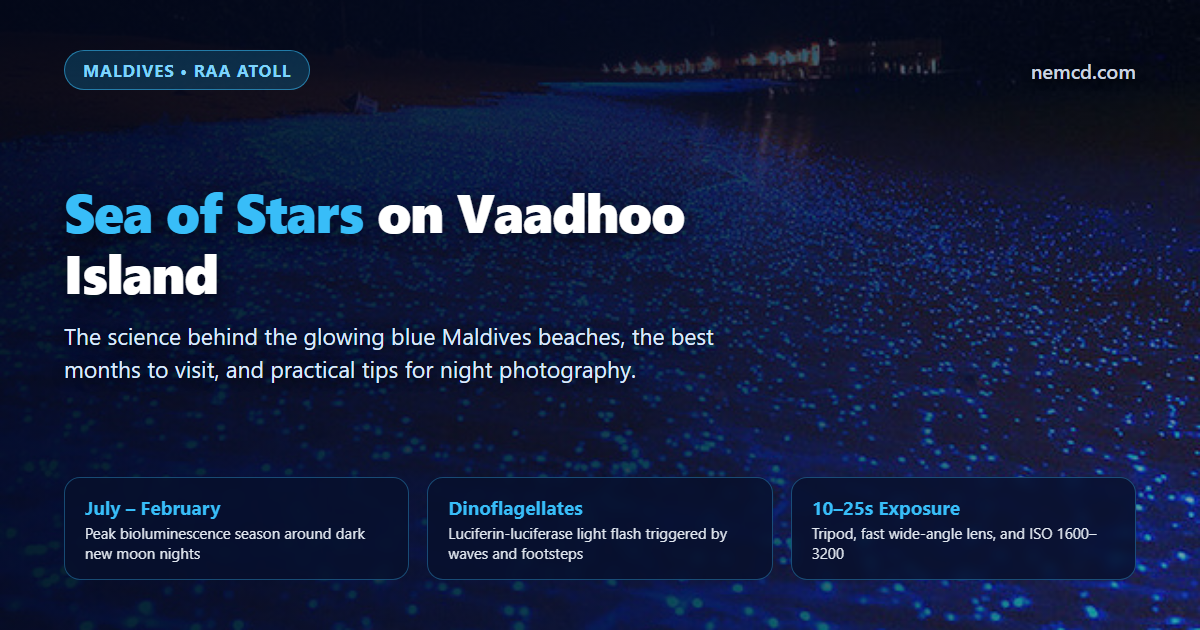 The Sea of Stars on Vaadhoo Island (Raa Atoll): bioluminescent plankton glowing electric blue in breaking night waves
Best known as the Sea of Stars on Vaadhoo Island in Raa Atoll, this seasonal phenomenon returns every year when millions of microscopic marine organisms light up the surf with electric-blue sparks.
 A ribbon of glowing blue plankton tracing the dark shoreline of Vaadhoo Island toward overwater villas
The Science Behind the Glow: Dinoflagellates & Luciferin
Despite looking like special effects, the electric-blue light is pure marine biology – bioluminescence produced by single-celled phytoplankton. The primary organisms responsible for the Maldives Sea of Stars are marine dinoflagellates such as Lingulodinium polyedrum and sea sparkle (Noctiluca scintillans).
When crashing waves, swimming fish, or footsteps disturb the water, mechanical stress triggers an enzymatic chemical reaction inside tiny cellular structures called scintillons: luciferase oxidizes a light-emitting compound called luciferin. Almost 100% of the energy releases as cold blue light (around 470–480 nm) rather than heat, serving as a defense flash to startle predators.
 Bioluminescent plankton flashing neon blue at the exact moment the night tide meets wet sand
 Stepping into wet coastal sand agitates millions of cells into outlining a glowing footprint
Safety note: during peak reproduction blooms, plankton density can grow so high that the surf looks like glowing blue milk – massive blooms are even visible from orbital satellites. Because some dinoflagellate species release irritating toxins during dense algal blooms, it is safest to admire heavy blooms from the dry shoreline rather than swimming in cloudy water.
Vaadhoo Island Travel Guide: Best Season & Getting There
While glowing plankton can appear across several atolls in the Indian Ocean, Vaadhoo Island in Raa Atoll remains the most famous destination for witnessing the Sea of Stars:
- Best months (July – February): monsoon transitions drive warm, nutrient-rich currents across the northern atolls, increasing plankton density from late summer through winter.
- New moon & dark skies: schedule your stay around a new moon and walk well away from bright jetty floodlights so faint blue flashes stand out clearly against dark water.
- Getting there from Malé: from Velana International Airport (Malé), take a 35–40 minute domestic flight to Ifuru Airport (Raa Atoll) followed by a 15–20 minute speedboat ride to Vaadhoo, or book a direct seaplane transfer to nearby Raa or Baa Atoll resorts.
 A trail of glowing footprints fading into the dark beach far from resort pier lighting
Night Photography Tips for Capturing Bioluminescence
To the naked eye, bioluminescence appears softer than long-exposure photographs suggest. To capture crisp blue waves without motion blur or muddy noise, follow these camera settings:
- Use a sturdy tripod: handheld night shots will smear tiny light points; plant tripod legs firmly in dry sand just above the waterline.
- 10–25 second exposure: long enough to gather delicate blue bioluminescence, yet short enough to preserve crisp wave contours rather than washing everything out.
- Fast lens & ISO 1600–3200: pair a wide-angle lens at f/1.4–f/2.8 with RAW capture so you can lift shadow detail cleanly in post-processing.
- Manual focus: autofocus struggles in near-total darkness – focus on a distant pier light or briefly shine a flashlight on wet sand, then switch the lens to manual focus (MF).