13 Animated Facts from the Animal Kingdom: Illustrations Inspired by QI

British artist and animator Michael Whaite created a series of 13 clever animated GIFs illustrating little-known facts about wildlife. The collection was inspired by the popular BBC panel show QI (Quite Interesting), whose research team has spent years digging up surprising scientific trivia.
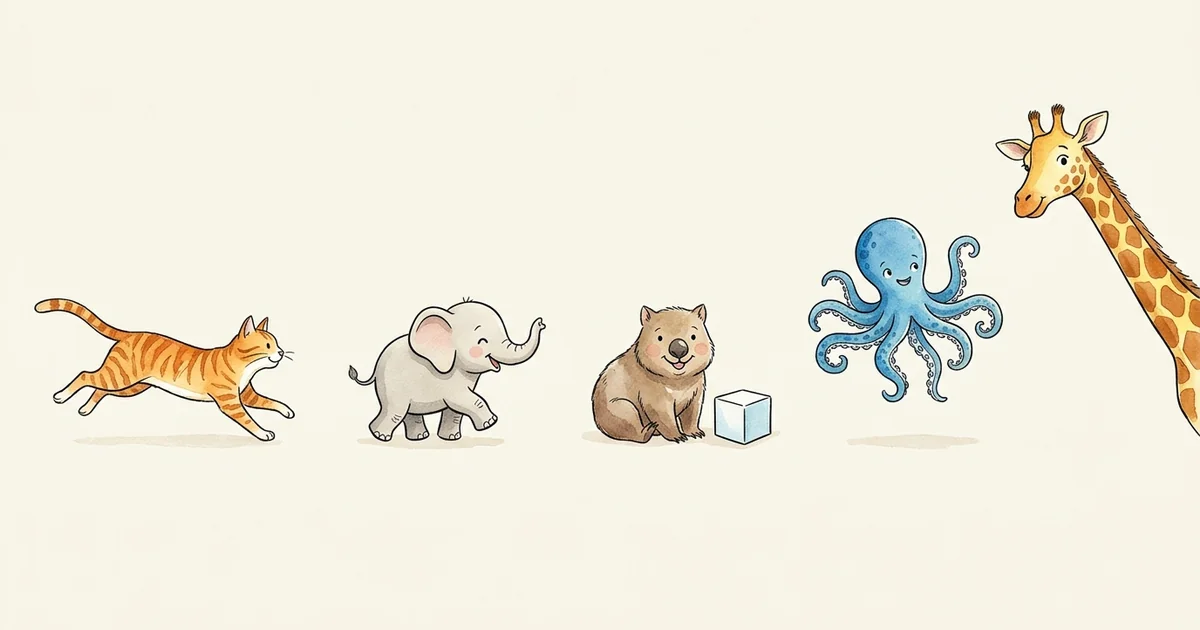
In short: here are all 13 animations with plain-English explanations – why a house cat outruns Usain Bolt, why wombat droppings come out as cubes, why early naturalists doubted the platypus, and what a praying mantis uses its single ear for.
1. A House Cat Can Outrun Usain Bolt
In a flat-out sprint, an athletic domestic cat can hit speeds around 30 mph (48 km/h). Usain Bolt’s peak top speed during his 2009 100-meter world record was about 27.8 mph (44.72 km/h) – so over a short dash, humans lose to a house cat.

2. Elephants Cannot Jump
An elephant’s legs are built like heavy vertical columns with thick cushioning pads in the feet rather than springy tendons. Between their massive body weight and joint anatomy, elephants physically cannot lift all four feet off the ground at once.

3. Turn a Shark Upside Down and It Enters a Trance
Carefully flipping a shark onto its back triggers a natural reflex called tonic immobility. Its muscles relax and the predator freezes for up to several minutes – a quirk marine biologists sometimes use when examining sharks or attaching tags.

4. Hippos Make Their Own Reddish Sunscreen Sweat
Hippopotamus skin secretes a thick reddish-orange fluid that early observers mistook for “blood sweat.” In reality, the pigments absorb UV rays to prevent sunburn while also acting as a natural antibacterial shield.

5. Squirrels “Kiss” to Identify Each Other
From a distance it looks affectionate, yet it is actually a quick scent check. Touching noses and mouths lets squirrels swap chemical cues and recognize members of their own family group.

6. A Praying Mantis Has a Single Ear Between Its Legs
Many praying mantis species hear through one cyclopean ear centered on the underside of the thorax between their hind legs. That sensor is tuned specifically to ultrasonic clicks so the mantis can dodge hunting bats in midair.

7. Giraffes Can Clean Their Own Ears with Their Tongue
A giraffe’s dark, prehensile tongue grows roughly 45–50 cm (18–20 inches) long – handy for stripping leaves from thorny acacia branches, and more than long enough to reach inside its own ears.

8. Male Lions Sleep Up to 20 Hours a Day
Adult male lions spend most of the daytime resting in the shade to conserve energy, saving their activity, territory patrols, and hunting bursts for cooler dusk and nighttime hours.

9. Moose Can Feel Insects Landing on Their Growing Antlers
In spring and summer, growing moose antlers are wrapped in living skin called velvet, packed with blood vessels and nerves – so a moose really can feel even a fly touching down. Once velvet sheds and mature antlers harden into dead bone, feeling fades, though their broad palmate shape still helps funnel sound into the moose’s ears.

10. Octopuses Have Blue Blood
Instead of iron-based hemoglobin, octopuses carry oxygen using a copper-rich protein called hemocyanin. When oxygenated in cold, low-oxygen ocean depths, it turns their blood a vivid blue.

11. Early Scientists Tried to Pull the Platypus’s Bill Off
When preserved platypus specimens first reached Europe in the late 1700s, zoologists assumed someone had sewn a duck’s bill onto a furry mammal as a taxidermy prank. Researchers actually inspected the skin with scissors, looking for hidden stitches.

12. Wombats Produce Cube-Shaped Poop
Wombats are the only known animals whose droppings come out as neat six-sided cubes. Varying elasticity along the lower intestine molds the flat edges – a clever evolutionary trick so territory markers stay stacked on rocks and logs without rolling away.

13. A Group of Rattlesnakes Is Called a “Rumba”
English collective nouns for animals get wonderfully strange – and a gathering of venomous rattlesnakes is genuinely known as a rumba of rattlesnakes, sharing its name with the Cuban ballroom dance.

Nature routinely outdoes fiction, especially when biologists with a sense of humor like the QI team dig into the details. Which of these animations or facts surprised you most?