When checking Nginx logs, you may occasionally come across a long warning: an upstream response is buffered to a temporary file. The site still loads normally, yet that line in error.log makes you wonder whether something is wrong with your configuration.

In short: this is not an error, but a standard notice saying that the backend response did not fit into Nginx’s RAM buffers, so the server temporarily spilled the remainder to a file on disk.
Read full article →
The error Fatal error: Call to undefined function gzinflate() (along with gzdecode() or gzuncompress()) means PHP was built or installed without the zlib extension. It most often shows up when moving a site onto a minimal VPS, FreeBSD server, or custom Docker image.

Checking whether the module is loaded takes one command, and enabling it usually takes just a couple of minutes.
Read full article →
Problem: site pages show Parse error: syntax error, unexpected $end.
In short: PHP reached the end of the file while code was still “open”. The usual culprits are short <? tags with short_open_tag turned off, or an unclosed curly brace. In newer PHP versions the same error reads syntax error, unexpected end of file.
Read full article →
I set up a new server with PHP 5.3.2 and its newly laid-out php.ini, and warnings immediately started showing up on the sites:
Warning: getdate(): It is not safe to rely on the system's
timezone settings. You are *required* to use the date.timezone
setting or the date_default_timezone_set() function. In case you
used any of those methods and you are still getting this warning,
you most likely misspelled the timezone identifier. We selected
'Europe/Helsinki' for 'EEST/3.0/DST' instead in ...
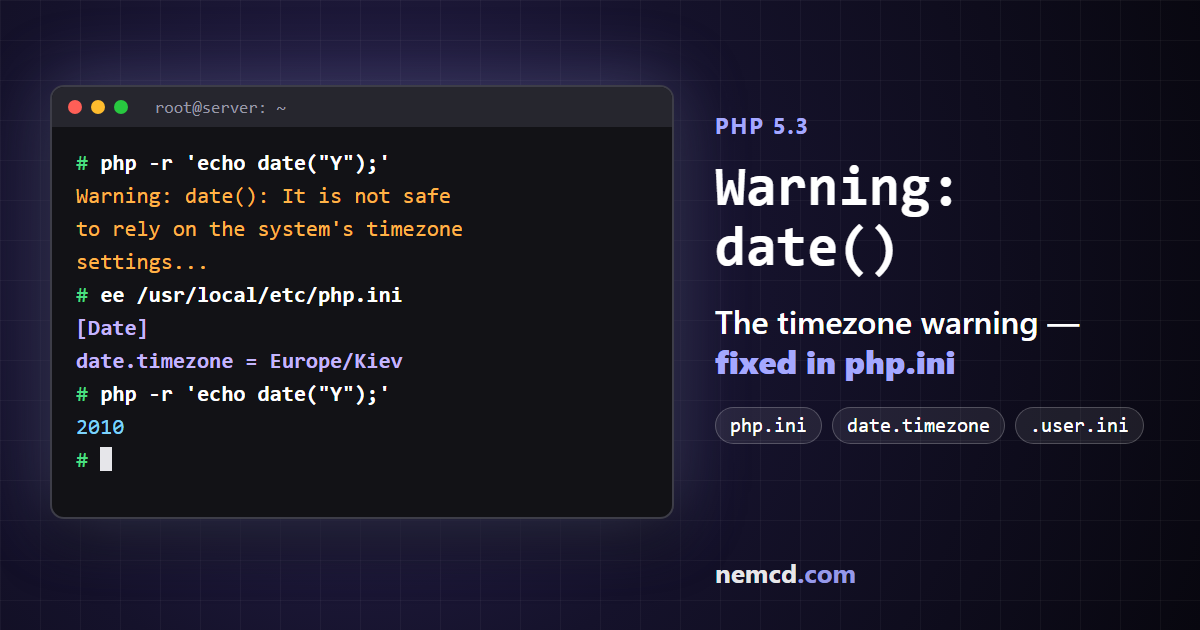
The same warning comes from date(), mktime() and strtotime(): in its older form it looks like Warning: date() [function.date]: It is not safe to rely on the system’s timezone settings. The cause is the same every time: starting with PHP 5.3 you have to set the timezone explicitly. It takes a minute to fix — here are three ways.
Read full article →
Back in March 2010, a new button called Sidewiki appeared under “Experimental features” in my Google Webmaster Tools dashboard (now Google Search Console). Curious about what Google was up to, I decided to test how it worked — and why the search giant wanted to overlay its own comment section on top of every website on the internet.
 Archive screenshot (March 2010): the Sidewiki (“WikiComments”) tab inside Google Webmaster Tools.
Read full article →