Deepest Metro Station in the World: Kyiv’s Arsenalna (105.5 m) and the Global Record

When you ride the Kyiv Metro every day, you quickly stop noticing how deep below the streets some of the lines actually run. That perspective hits you on a long upward escalator ride at Zoloti Vorota – you stand there for a couple of minutes, glance up toward the surface, and suddenly realize there is an entire city building’s worth of earth and rock sitting right above your head.
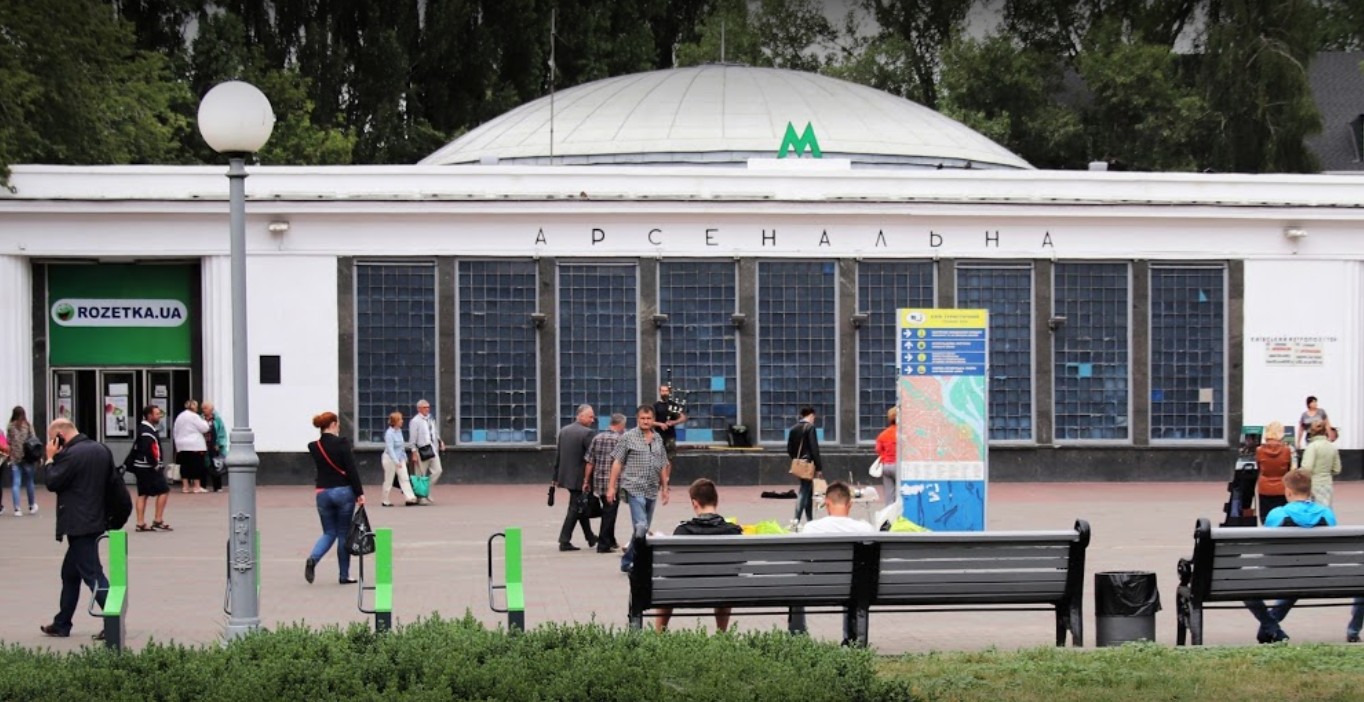 Arsenalna station in Kyiv – 105.5 meters underground and the deepest metro station in Europe
For decades, Kyiv’s Arsenalna station topped rankings of the world’s deepest metro stations. Although a newer Chinese station recently claimed the global depth record, Arsenalna remains the deepest station anywhere in Ukraine and all of Europe.
How Arsenalna was built and why it sits so deep
Arsenalna opened on November 6, 1960 as part of the Kyiv Metro’s original launch line and took its name from the nearby Arsenal plant. Its platforms sit 105.5 meters (about 346 ft) below street level because engineers had to bore beneath the steep right bank of the Dnipro River before emerging back into the open air right after the station.
Structurally, Arsenalna is rare across the former USSR: instead of the wide three-vault central halls common to Soviet deep-level stations, it follows the “London” (English) layout with a very short central hall connecting the two platform tunnels. Because of water-saturated soil overhead, builders constructed the intermediate vestibule inside a massive reinforced-concrete caisson gradually sunk into the hill. Just one stop further east, the Dnipro station sits completely above ground on a viaduct overlooking the river – making the elevation shift one of the sharpest in rapid transit.
 The small domed surface pavilion opens onto Arsenalna Square and Ivan Mazepa Street
Up top, passengers exit through a compact round domed pavilion on Arsenalna Square near Ivan Mazepa, Mykhaila Hrushevskoho, and Knyaziv Ostrozkykh streets. Reaching the surface takes two consecutive three-lane escalators – an upper flight lifting around 46.6 meters and a lower flight of 55.8 meters – separated by an underground transfer vestibule.
Deepest metro stations in the world: Kyiv vs Chongqing
For more than half a century, Arsenalna held the widely accepted global record of 105.5 m, aside from unverified reports attributing 100–120 m to Pyongyang’s Puhung station. Starting in 2022–2023, however, China’s Chongqing Rail Transit took over the #1 spot:
- Hongyancun (Chongqing, China): roughly 116 m deep – opened in Chongqing’s mountainous terrain and now holds the verified world depth record.
- Arsenalna (Kyiv, Ukraine): 105.5 m – still the deepest metro station in Ukraine, Europe, and the post-Soviet space (with Pecherska and Zoloti Vorota nearby in Kyiv also ranking among the deepest).
- Puhung (Pyongyang, North Korea): commonly estimated around 100 m, though official engineering measurements have never been published.
- Admiralteyskaya (Saint Petersburg, Russia): 86 m – similarly uses two sequential escalator flights.
- Washington Park (Portland, United States): about 79 m – North America’s deepest underground station, served by high-speed elevators.
- Park Pobedy (Moscow, Russia): 73 m – known for one of the longest single-flight escalators in the region.
Two escalator flights, speed, and fear of heights underground
An underrated design perk of Arsenalna is that split two-flight escalator layout. On single-shaft stations plunging 65–75 meters in one unbroken slope, standing for five straight minutes looking down a steep tunnel can trigger vertigo. At Arsenalna, even though the total vertical drop is greater, that midpoint vestibule lets you catch your breath or sit down on a bench for a moment.
Escalator speed makes a noticeable difference too: Kyiv Metro deep-station escalators have traditionally run around 0.85–0.94 m/s (compared with ~0.75 m/s on older units in some cities). Combine a fast incline, the slight mismatch between step speed and handrail speed, and enclosed tunnel walls, and some riders develop genuine escalator anxiety or claustrophobia – ranging from mild dizziness to sudden panic.
Most people who struggle with deep escalators cope by looking straight at the crowd ahead or focusing on their phone rather than staring down the shaft, or by switching to surface buses on tough days. Whether you find underground engineering fascinating or slightly intimidating, deep stations like Arsenalna remain one of the fastest ways to cross a sprawling riverfront city without getting stuck in traffic.