The Blackest Material in the World – Vantablack

In July 2014 at the Farnborough Airshow, British company Surrey NanoSystems and the UK’s National Physical Laboratory (NPL) unveiled the darkest artificial material in the world – Vantablack. The coating absorbs 99.965% of incident light and visually erases every contour of a textured object, turning it into a flat black void.
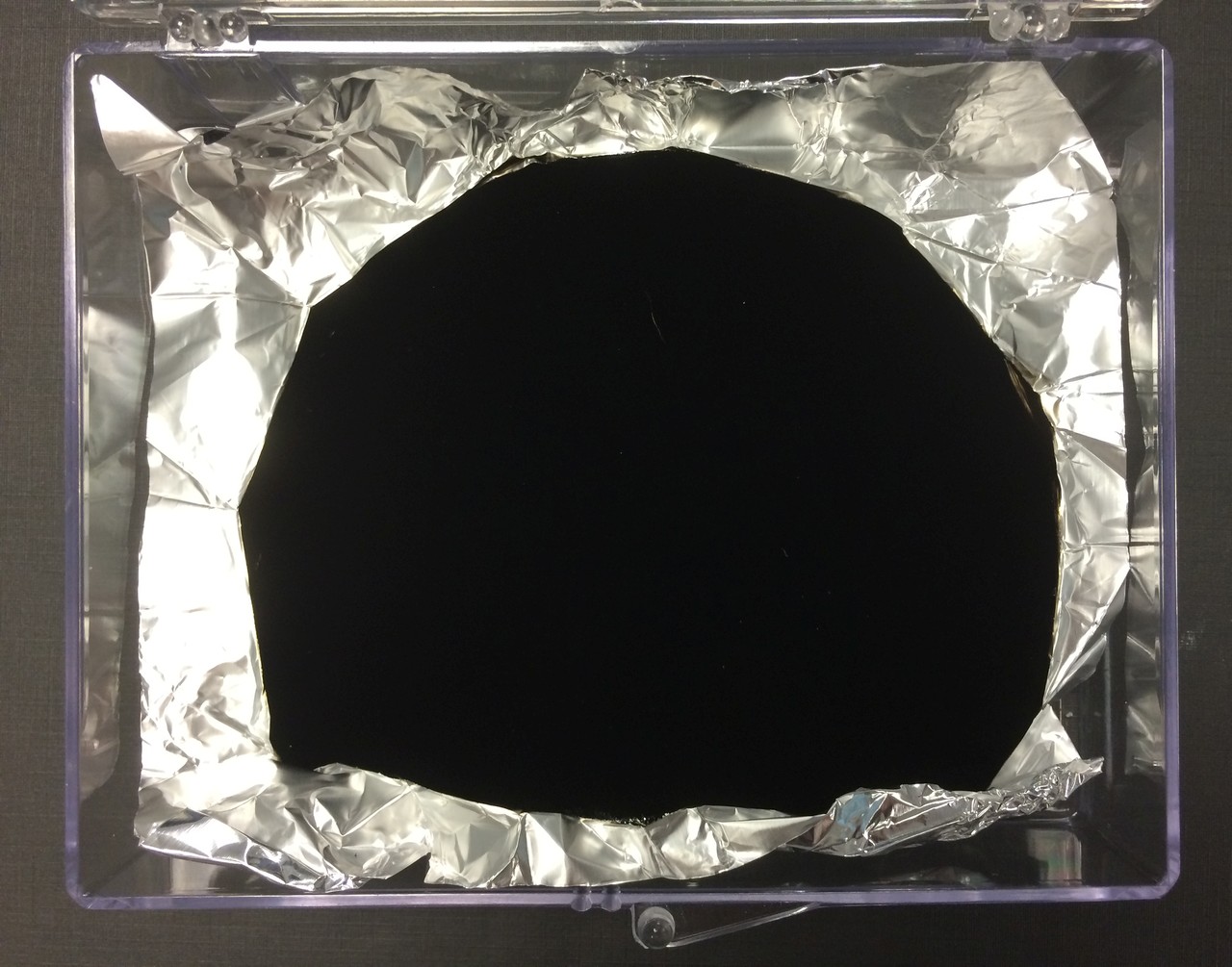 Vantablack coating on crumpled aluminum foil: all folds and contours vanish inside the black patch
The name Vantablack combines the acronym VANTA (Vertically Aligned NanoTube Arrays) with the word black.
How Vantablack Works and Why It Reflects Almost No Light
Unlike ordinary black paint or soot, Vantablack is not a pigment at all. It is a microscopic “forest” of carbon nanotubes grown vertically inside a reactor:
- Record 99.965% absorption: According to National Physical Laboratory measurements at a 750 nm wavelength, the material reflects only 0.035% of light, absorbing visible, ultraviolet, and infrared radiation (by comparison, the darkest coal and matte black paints absorb around 95–96% of light).
- 10,000 times thinner than hair: Each carbon nanotube is about 20 nanometers wide and 14 to 50 microns tall – roughly 3,500 to 10,000 times thinner than a human hair, packing around a billion tubes onto a single square centimeter.
- A trap for photons: The array is 99.9% empty space, so light does not bounce off the outer boundary and instead drops straight into the forest. Inside, photons scatter repeatedly between the nanotube walls like in a maze until almost all of them are absorbed and converted into heat.
- Low-temperature growth on aluminum: Earlier chemical vapor deposition (CVD) methods required temperatures above 700 °C, which would melt aluminum right away. Surrey NanoSystems engineered a process at roughly 400 °C, making it possible to grow the coating directly on thin aluminum foil and lightweight satellite components.
When you look at an object coated in Vantablack, your brain struggles to make sense of the scene. On a crumpled sheet of foil, edges, creases, and shadows disappear completely – your eyes see neither texture nor depth, only what looks like an empty black hole.
Key Properties and Real-World Uses
Beyond its optical performance, the coating inherits the physical strengths of carbon nanotubes: it conducts heat 7.5 times better than copper and has 10 times the tensile strength of steel. It barely outgasses in a deep vacuum, stays intact under rocket-launch vibrations, and survives extreme thermal shock down to liquid nitrogen temperatures (−196 °C).
Because of that combination, Vantablack was built primarily for space, precision optics, and defense:
- Space telescopes and star trackers: Coating internal baffles and optics removes stray glare from the Sun and Moon, helping sensors detect faint stars and distant galaxies.
- Infrared camera calibration: Because it absorbs heat so completely, the surface serves as a blackbody reference for calibrating thermal imagers and orbital radiometers.
- Microelectronics and thermal control: Engineers use it in miniature MEMS components, solar absorbers, and thermal protection systems; Surrey NanoSystems cannot comment on defense contracts, and sums up the price simply as “very expensive” :-)
Surrey NanoSystems CTO Ben Jensen once joked that if someone wore a dress made of Vantablack, bystanders would only see a floating head, hands, and feet around a flat, featureless silhouette. In reality, you couldn’t actually wear or handle it like fabric – even a light touch crushes the delicate nanotubes and leaves a shiny mark. Still, you have to admit it would be pretty cool to have a small piece of that foil sitting on a desk just to mess with your eyes :-)