Consequences of Sleep Deprivation: Health Impact and Sleep Hygiene

I catch myself running short on sleep more often than I should, even though I know how bad it is for energy, focus, and daily discipline. Somehow late nights still win out: one evening you stay up past 3 AM and wake up at 7 AM, then on the weekend you sleep in past noon and cannot fall asleep at 11 PM.
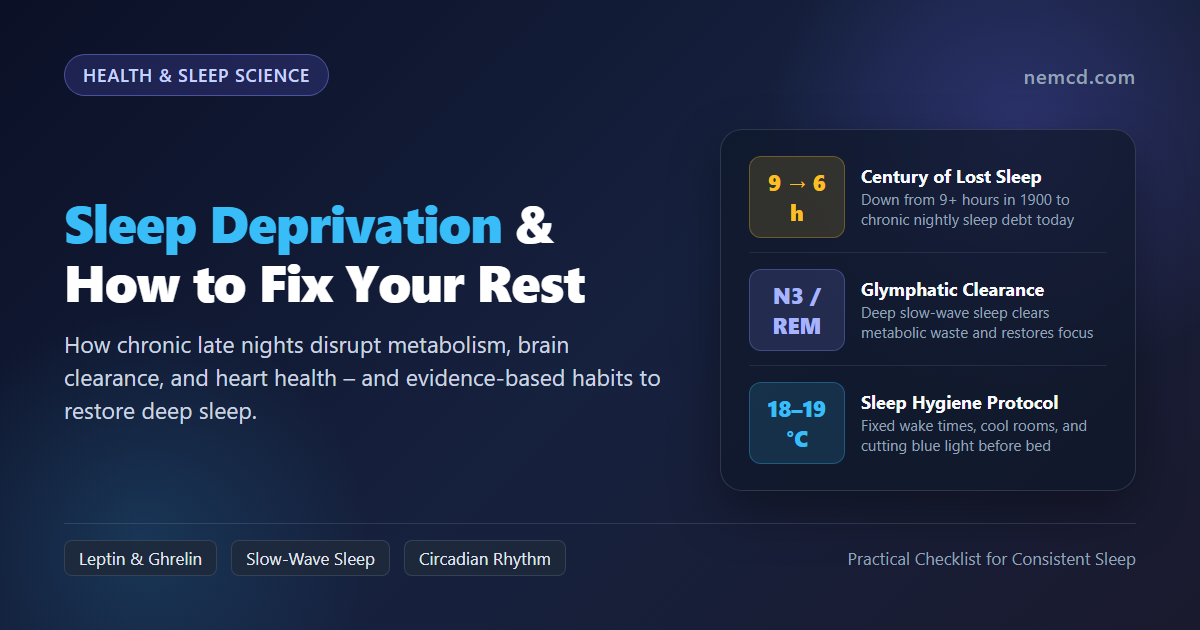 Chronic sleep debt disrupts appetite hormones, slows glymphatic brain clearance, and strains the cardiovascular system
At some point, willpower alone is not enough. To fix a broken schedule, it helps to understand what chronic sleep debt actually does to your metabolism, brain, and cardiovascular system, and which practical habits restore deep, restorative rest.
Sleep Debt, Appetite Hormones, and Weight Gain
Canadian researchers demonstrated years ago how strongly insufficient sleep affects body weight, starting in childhood. In a study of 422 children aged 5 to 10, clinicians measured weight, height, and waist circumference while parents completed detailed questionnaires on lifestyle and family socioeconomic status.
The findings were striking: about 20% of boys and 24% of girls sleeping fewer than 10 hours a night carried excess weight – roughly 3.5 times more often than children sleeping 12 hours or longer. Even parental weight, education, income, television or computer time, and physical activity showed weaker associations with excess weight than short sleep duration.
Modern endocrinology explains this link through two core appetite-regulating hormones:
- Leptin drops: satiety signaling between fat stores and the brain weakens, so normal portions no longer feel filling.
- Ghrelin rises: hunger signaling ramps up, pushing a sleep-deprived brain toward quick carbohydrates, sweets, and late-night snacks.
- Insulin sensitivity falls: even a few consecutive nights of 5–6 hours impair glucose clearance, turning late fridge raids into steady fat storage.
A Century of Lost Sleep – and Why Weekends Cannot Fix It
Long-term trends show a sharp drop in nightly rest: in the early 1900s, people averaged more than 9 hours of sleep; by the 1960s, that figure stood above 8 hours; today, average sleep duration has fallen below 6.5 hours, hovering around 6 hours for many desk workers.
Most adults need 7–9 hours of quality sleep, while children and teenagers require 9–11+ hours. With a typical 9-to-6 workday and frequent overtime, getting home at 8 PM or later leaves little room for a calm evening. A heavy late dinner followed by screens until 1 AM and a 6–7 AM alarm quickly builds chronic sleep debt.
Trying to erase five short nights by sleeping late on Saturday and Sunday rarely solves the problem. Shifting your wake time by several hours triggers social jetlag: your circadian clock drifts forward, Sunday night turns into staring at the ceiling, and Monday morning feels just as exhausting.
What Happens to Your Brain and Heart: Modern Sleep Science
By 2026, sleep neuroscience has mapped out why cutting sleep short hits far harder than simple daytime drowsiness. Healthy sleep cycles alternate between two distinct phases:
- Deep slow-wave sleep (SWS / N3): concentrated in the first half of the night, when heart rate and breathing slow, growth hormone surges, tissues repair, and metabolic balance resets.
- REM sleep: concentrated toward morning, supporting memory consolidation, learning, and emotional regulation. Setting an early alarm after a late bedtime slices directly into REM cycles.
Equally important is the brain’s glymphatic clearance system. During deep slow-wave sleep, the interstitial space between brain cells expands, allowing cerebrospinal fluid to flush out metabolic waste accumulated during waking hours – including beta-amyloid and tau proteins. Cutting sleep down to 5 or 6 hours leaves that nightly cleanup unfinished.
Ongoing sleep restriction undermines multiple systems at once:
- Cognitive decline: prefrontal cortex efficiency drops, hurting sustained attention, reaction speed, working memory, and decision-making.
- Cardiovascular strain: chronic sleep loss keeps sympathetic nervous tone elevated, prevents the normal nighttime dip in blood pressure, and raises long-term risk for hypertension and heart disease.
- Immune fatigue: sleeping fewer than 6 hours weakens resistance to common infections and slows physical recovery.
Practical Sleep Hygiene Checklist
Restoring healthy sleep does not require extreme routines. Locking in a few consistent habits makes the biggest difference:
- Fixed wake time: wake up at the same hour every day, including weekends (within a 30–60 minute window). A steady wake time anchors your circadian rhythm far better than forcing an early bedtime.
- Dim blue light early: lower bright overhead lighting, enable warm screen filters, and step away from work chats or news feeds 2 hours before bed so natural melatonin can rise.
- Cool bedroom (18–19 °C): your core body temperature must drop slightly to enter deep slow-wave sleep. Ventilate the room before bed and keep the space dark and quiet (around 64–66 °F).
- 8-hour caffeine cutoff: stop drinking coffee, strong tea, and energy drinks at least 8 hours before bedtime; even if you fall asleep easily, lingering caffeine fragments deep N3 sleep.
- Evening walk and light dinner: avoid unnecessary overtime, walk part of the way home to unwind outdoors, and swap heavy late-night sandwiches for a light dinner 2–3 hours before bed (such as warm porridge or a simple grated carrot or beet salad) followed by caffeine-free chamomile tea.
Once your wake time, evening lighting, and bedroom temperature align, falling asleep stops feeling like a battle. Stick with the routine for a week or two, and mornings become noticeably sharper. Stay healthy and sleep well!