Mining Siberian Chervonets (SIB): My CPU Mining Experiment and How It Ended

If you can call me a geek, then just like any other computer geek I feel a mix of mild confusion and genuine sympathy toward cryptocurrencies. For me, that whole story started back in 2011 when I first learned about Bitcoin.
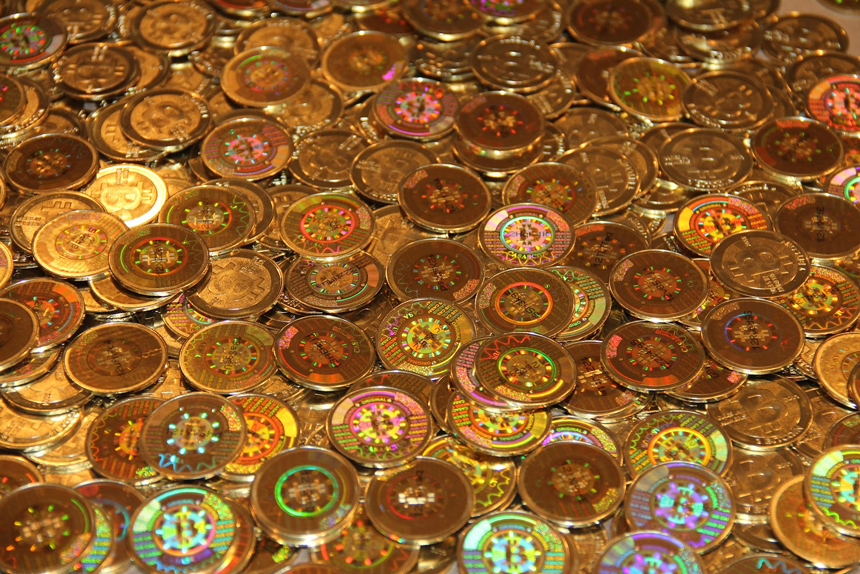 I first came across cryptocurrencies back in 2011
In August 2015, I decided to run an experiment and mine a new altcoin – Siberian Chervonets (Sibcoin, ticker SIB) – on my Intel Core i7-2600 processor to see how much money it actually makes.
Why Confusion and Sympathy Toward Cryptocurrencies
Why confusion? Something appeared out of thin air: today it is worth pennies, tomorrow it might jump tenfold, or it might lose its value altogether.
As for sympathy, that part is simple: first Bitcoin appeared out of nowhere, then Litecoin, and then dozens of other forks. Computers crunch endless hashes, and out come virtual digital tokens that you can exchange for very real cash!
 Virtual hashes and numbers that can be swapped for real cash
Most of the people who got into this early – mining cryptocurrency, trading on exchanges, or building and selling mining hardware (ASIC miners, Butterfly Labs boards, and so on) – made good money. Some are still making money today, though it has become much harder since Bitcoin’s price dropped compared to its late-2013 and 2014 highs.
 Bitcoin price chart by August 2015: cooling off after the late-2013 peak
Bitcoin itself is currently shaken by block-size debates (splitting votes and branches), bans in various countries, and swings in investor confidence. In short, times are not easy.
Still, let’s get back to the main topic. My point is that the key with new cryptocurrencies is catching the launch early: that is when you can mine or buy up coins without giant farms and wait for the price to take off.
What Is Siberian Chervonets (SIB)
 Logo of the Siberian Chervonets (SIB) cryptocurrency
Siberian Chervonets (Sibcoin, ticker SIB) launched in spring 2015 without a premine. Here are its core network specs:
- Launch date: May 9, 2015 at 01:00 Moscow time (created by Ivan Rublev).
- Hashing algorithm:
X11Gost– the classic 11-algorithmX11chain extended with the Russian national standard hash function “Streebog” (GOST R 34.11-2012). - Block reward: calculated dynamically using the formula
2222222 / (((Difficulty + 2600) / 9) ^ 2)with Dark Gravity Wave difficulty retargeting. - Mining hardware: CPU mining at launch (directly from the wallet or via a console miner), with GPU mining in testing.
- Maximum supply: estimated at 23–24 million coins as network difficulty rises and the block reward drops toward the minimum of 5 SIB.
- Network features: a two-tier network with masternodes (for instant and private transactions) plus plans for paper wallets to make peer-to-peer transfers easier.
If you open the “About” dialog in the wallet, it becomes obvious right away that Siberian Chervonets is a fork of Darkcoin (rebranded to Dash in March 2015): the developers took the proven masternode codebase, swapped the logo, and added the GOST hash function to the X11 algorithm.
 The “About” window shows that the SIB wallet is built on Bitcoin and Darkcoin (Dash)
Test Setup and Antivirus Warnings
I did not want to install obscure miners or a brand-new wallet on my main PC where I keep my browsers, Skype, and other wallets.
Even while downloading most miners, Google Chrome flags the archive as malicious software and blocks it. If you force Chrome to keep the file, Kaspersky Antivirus immediately steps in and wipes the .exe binary on the spot (antivirus engines flag miner signatures because the exact same hashing modules are often bundled into botnets for hidden background mining).
So for this experiment I set up a dedicated clean hard drive with nothing but a fresh Windows install and 360 Total Security – no personal files or saved passwords.
Step 1. Solo Mining Directly from the SIB Wallet
First, I decided to try built-in CPU mining straight from the SIB wallet. Open Tools – Debug console and run:
setgenerate true
My Intel Core i7-2600 (3.40 GHz, 4 physical cores and 8 threads) immediately jumped to 100% load across all cores. It crunched away for about an hour without finding a single block.
It turned out that during the few days I spent looking into the coin, network difficulty had jumped more than fourfold, two mining pools had opened, and solo mining on a single home CPU was no longer realistic. To stop solo mining in the debug console, run:
setgenerate false
Step 2. Pool Mining with minerd
At the time of my test, there were two main pools for mining Sibcoin: pool.chervonec.com and digger.pw.
On the first pool (pool.chervonec.com), you had to sign up, activate an account, manually create workers and passwords, and read through a confusing help page – it did not work out of the box, so I moved on to the second pool.
The second pool (digger.pw) charged a slightly higher fee, but the setup was dead simple: your SIB wallet address is your username, any string works as the password, and your live stats page opens directly by wallet address.
I downloaded the custom build of the console CPU miner minerd compiled for Siberian Chervonets (X11Gost), restored the binary after my antivirus quarantined it, and created this Windows .bat file:
set WALLET=Sgq3jN3JtAJvn6XVdvAZsexxmUL1yGC5T6
set POOL=stratum+tcp://stratum.digger.pw:3333
minerd -a X11 -u %WALLET% -p 3899 -o %POOL%
Note one important detail: in the earliest Sibcoin-specific builds of minerd, the developers replaced the standard X11 algorithm with X11Gost directly inside the source code, so the command line still used the old -a X11 flag. An unmodified cpuminer with -a X11 will not work for Sibcoin – in newer multi-algorithm miners (cpuminer-multi, ccminer, sgminer), Siberian Chervonets uses its own dedicated flag, -a sib.
Across all 8 threads of the Intel Core i7-2600, the miner reached about 102–103 kH/s in total (around 12.8 kH/s per thread):
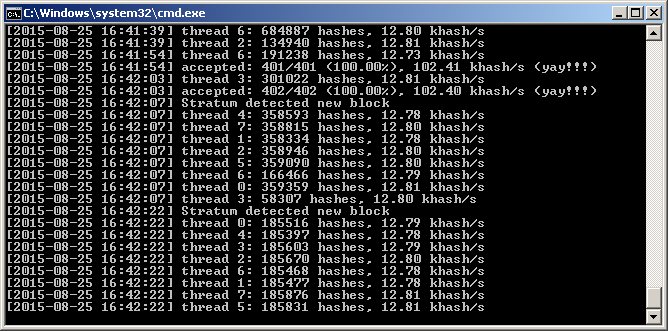 minerd running on 8 threads of an Intel Core i7-2600 delivers about 102–103 kH/s
Here is what the digger.pw pool dashboard showed after an hour of continuous mining:
 Pool statistics on digger.pw after one hour: estimated output is about 92 SIB per day
Profitability Math: How Much Money It Makes
According to the pool stats, running an Intel Core i7-2600 at 100% load for 24 hours straight yields roughly 92 SIB per day. At the time of my experiment, the exchange sell price for one SIB was 0.0000220 BTC, with Bitcoin trading at $226:
 SIB/BTC order book in August 2015: trading around 0.0000220 BTC per coin
Let’s calculate the value of one coin and the daily revenue:
- Price of 1 SIB:
0.0000220 BTC × $226 = $0.004972– roughly 0.5 cents (half a US cent per coin). - 24-hour revenue (92 SIB):
92 × $0.004972 = $0.457– about $0.46 per day on a fairly capable desktop CPU.
Brutal! And you still have to sell those coins into a thin order book without crashing the price yourself :-)
In total, I let the pool miner run for about 4 hours. The next day I opened my wallet and saw my “fortune” – 11.42 SIB:
 First pool payout in the wallet – 11.42 SIB after 4 hours of mining
I did not feel like torturing my processor any further for 46 cents a day. Several practical lessons stood out from this test:
- Home hardware and power: mining on a regular PC only makes sense in the very first days after launch, or if you have free hardware and electricity.
- Buying early: instead of running fans at full blast 24/7, it is much simpler to buy a hundred coins for half a dollar (or a thousand for $5) when a coin hits an exchange – sell half if it pumps, and hold the rest for better times.
- Miner security: precompiled miners can easily hide trojans that steal wallets and passwords, so it is safer to inspect the source code and compile the miner yourself (or run it on an isolated drive).
- The biggest lesson: the most profitable move of all is launching your own coin and keeping a premine :-)
How It All Ended: The 2017 Surge to $6 and Decline
The most interesting twist came two years after this experiment. In autumn 2015, GPU miners were released for the X11Gost algorithm (ccminer for Nvidia and sgminer for AMD), and later dedicated Baikal ASIC miners arrived and pushed home computers out of the picture completely.
Then, during the massive 2017 crypto bull run, those “better times” actually arrived for Siberian Chervonets:
- October 2017: SIB climbed past $1 per coin (as readers quickly pointed out in the comments below).
- December 27, 2017 (all-time high): the price spiked to $6.08 – more than 1,200 times higher than the half-cent price in August 2015!
At that late-2017 peak, a single day of my 2015 CPU mining (92 SIB), which looked like a measly $0.46 at the time, would have been worth $559 per day. And a thousand coins bought for $5 in August 2015 would have turned into roughly $6,000. Sadly, by the time SIB hit those highs, I didn’t even have my eleven test coins left.
Of course, the party did not last forever: the long 2018 “crypto winter” dragged SIB back down to pennies, the old mining pools (pool.chervonec.com, digger.pw, polza.online) shut down, and one by one exchanges delisted the coin. Today the project is effectively abandoned with zero trading volume – a classic reminder that with small altcoins, timing your exit matters just as much as getting in early.
If you want to buy cryptocurrency today without noisy rigs or shady mining pools, it is much easier to buy Bitcoin or other major coins directly on an exchange such as Binance (affiliate link). Just remember that cryptocurrency prices are highly volatile, so never invest more than you can afford to lose.