Recently, while migrating websites to a new server and a new IP address, I moved all files cleanly and updated the domain DNS records. During propagation, I kept an eye on how quickly visitors would start reaching the site on the new server.
 Domain Name System (DNS): caching and record propagation
Yandex’s public DNS servers (77.88.8.8) updated almost immediately and started returning the new IP (possibly helped by my 3600-second TTL expiring right around then). Google Public DNS (8.8.8.8), however, stubbornly kept serving the old IP. I even removed Google’s resolvers from my local unbound caching DNS config on one server and kept only Yandex (latency to 77.88.8.8 was also 2–4x lower from my ISP than to 8.8.8.8).
Read full article →
When Oracle acquired Sun Microsystems, original MySQL creator Michael Widenius forked the project into MariaDB to guarantee an open GPL-licensed database. Today MariaDB ships as the default SQL server on Debian, RHEL/Rocky/AlmaLinux, and millions of web hosts, while MySQL 8 continues evolving on its own track. Here is how they actually differ and which one fits your server best.


Quick verdict: for WordPress, PHP apps, e-commerce sites, and standard Linux stacks, MariaDB (current LTS lines 10.11 and 11.4) is the easiest, lightest default choice. Choose MySQL 8.0 / 8.4 if your framework or SaaS product explicitly depends on native MySQL binary JSON or Oracle-specific plugins.
Read full article →
On a new server I ran into this: the CPU is an Intel Pentium G2020 @ 2.90GHz, yet Debian shows a frequency of 1600 MHz. The first thing I did was check the frequency and memory:
grep MHz /proc/cpuinfo ; grep MemTotal /proc/meminfo

The memory was fine (8 GB), but the frequency was puzzling. Where does 1600 MHz come from instead of 2900?
Read full article →
Sometimes you need to move a whole bunch of servers saved in PuTTY to another computer. Adding them by hand is a pain, and it takes a long time.
In short: PuTTY stores its settings not in a file next to putty.exe but in the Windows registry, under HKCU\Software\SimonTatham\PuTTY (HKCU stands for HKEY_CURRENT_USER). Saved sessions are in the Sessions subkey. To move them, export this key to a .reg file and import it on the new computer.
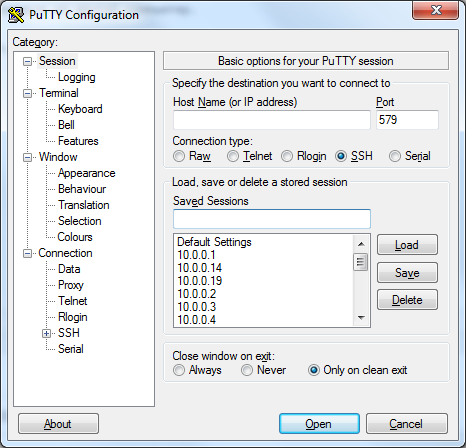
Let me show you where exactly everything is and how to move your sessions in a couple of minutes.
Read full article →
If you flashed an Ubuntu, Linux Mint, Debian, or other Linux ISO onto a USB drive and your PC stalls at boot with a black screen saying failed to load ldlinux.c32 (or Missing parameter in configuration file), the Syslinux bootloader on the flash drive was written incorrectly.

This error happens most frequently with tools like UltraISO or older builds of UNetbootin: they unpack the ISO onto a FAT32 partition and install their own Syslinux version, which clashes with the ldlinux.c32 binary bundled inside the Linux ISO.
Read full article →
