Stag Beetle: Photos, Interesting Facts and Why You Shouldn’t Catch It
The stag beetle is the largest beetle in Europe and probably the most recognizable one. Its famous “antlers” are actually hugely enlarged upper jaws (mandibles) that males use to fight each other over females and the best spots on trees.
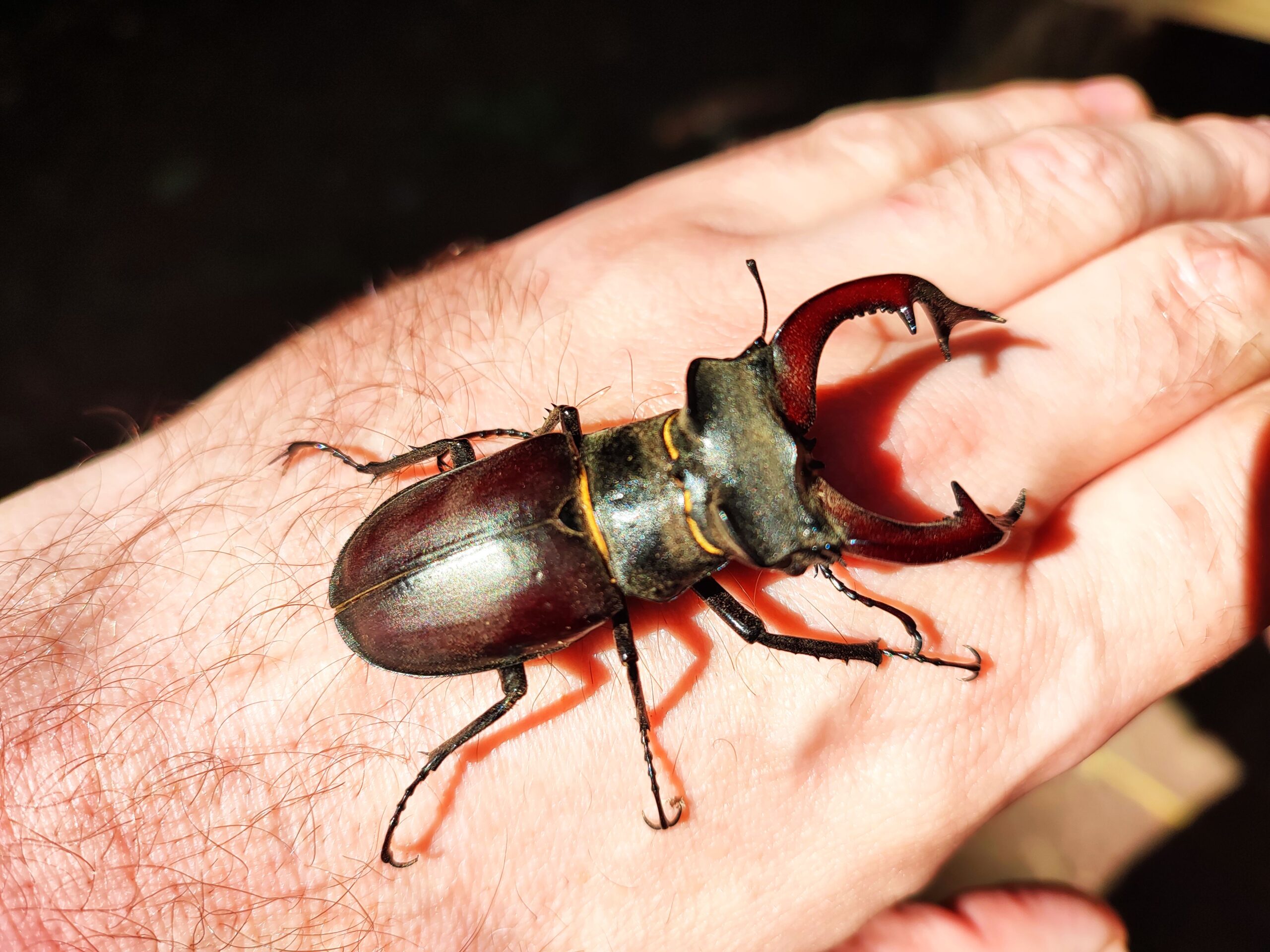
What a stag beetle looks like
- The male is up to 8–9 cm long including the “antlers”. The body is black-brown, and the wing cases and mandibles are reddish-brown.
- The female is noticeably smaller and has no “antlers”: her jaws are short, but she bites harder than the male.
- Its Latin name is Lucanus cervus, from the stag beetle family (Lucanidae).
Where it lives and when you can see it
The stag beetle lives in Europe, in old oak and mixed forests, parks and gardens with old trees and rotting stumps. Adult beetles can be seen from late spring to mid-summer, especially on warm evenings, when the males fly around looking for females.
3 interesting facts about the stag beetle
1. It flies almost “standing up”. Because of its heavy jaws, the male’s center of gravity is shifted forward. To keep from nose-diving, it flies with its body tilted steeply, almost upright, making a low hum — like a little drone.
2. The larvae “talk”. Stag beetle larvae can make a chirping sound (stridulation) by rubbing ridges on their middle legs against grooved plates on their hind legs. This is apparently how they signal their presence to neighbors inside a rotting log.
3. As an adult, it lives only a few weeks. The beetle spends almost its whole life — from 3–5 to 6–8 years — as a larva in rotting wood, mostly oak. The adult lives just a few weeks: long enough to find a mate and lay eggs before it dies. It feeds on tree sap and the sweet juice of overripe fruit.
Why it needs protection
The stag beetle is listed in the Red Data Book of Ukraine and is protected in many European countries. The main reason for its decline is the felling of old oak forests and the “sanitary” clearing of old stumps and dead wood: the larvae simply have nowhere to live.
If you find a stag beetle:
- take a photo and let it go — don’t catch it, keep it at home or add it to a collection;
- don’t dig out old stumps in your garden if a larva might live in them;
- the male is harmless, but the female can give you a painful pinch — handle her carefully or not at all.
I’m always happy when I find a stag beetle — you have to admit, it looks impressive. In Kharkiv, there is even one on the gates of Gorky Park.
